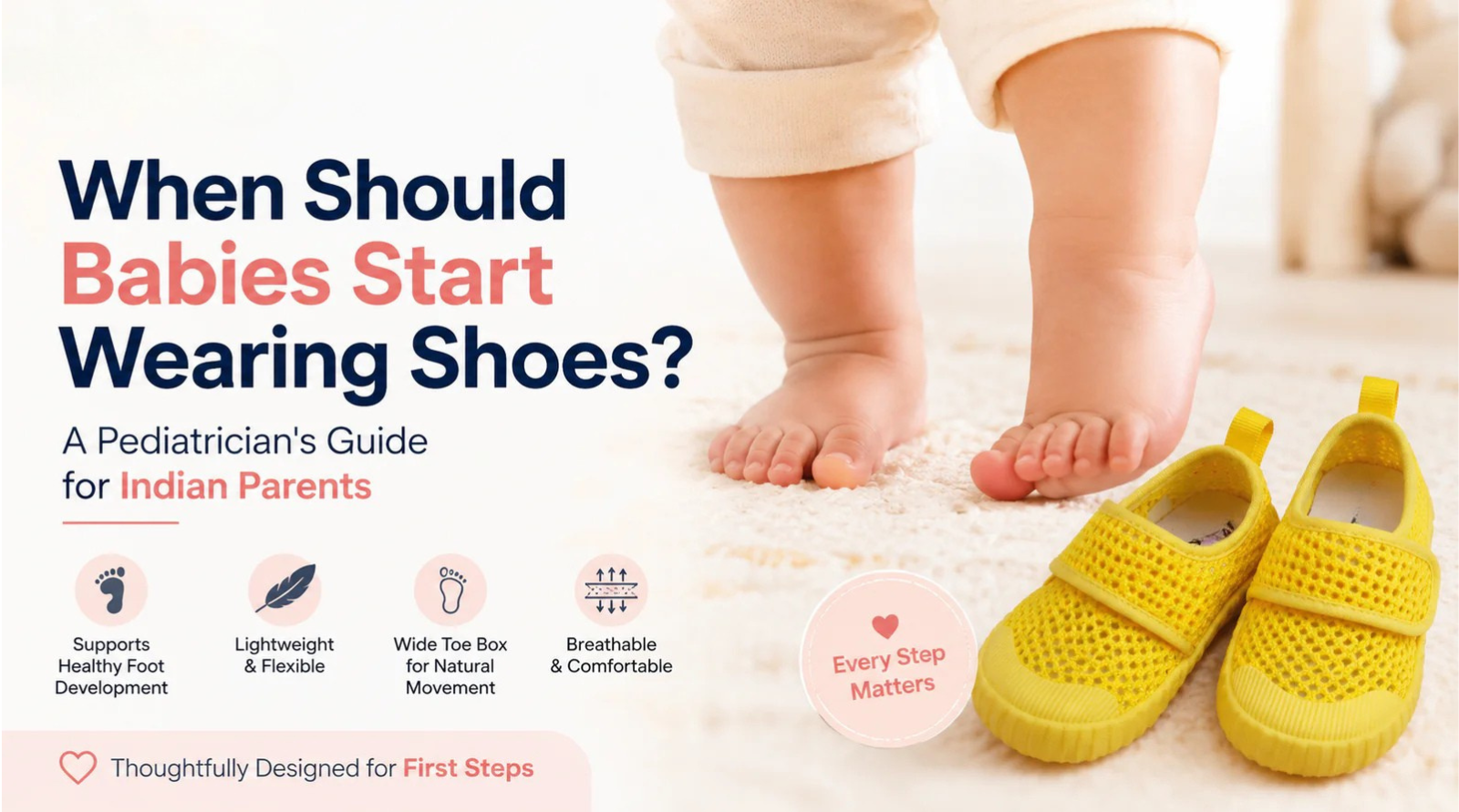
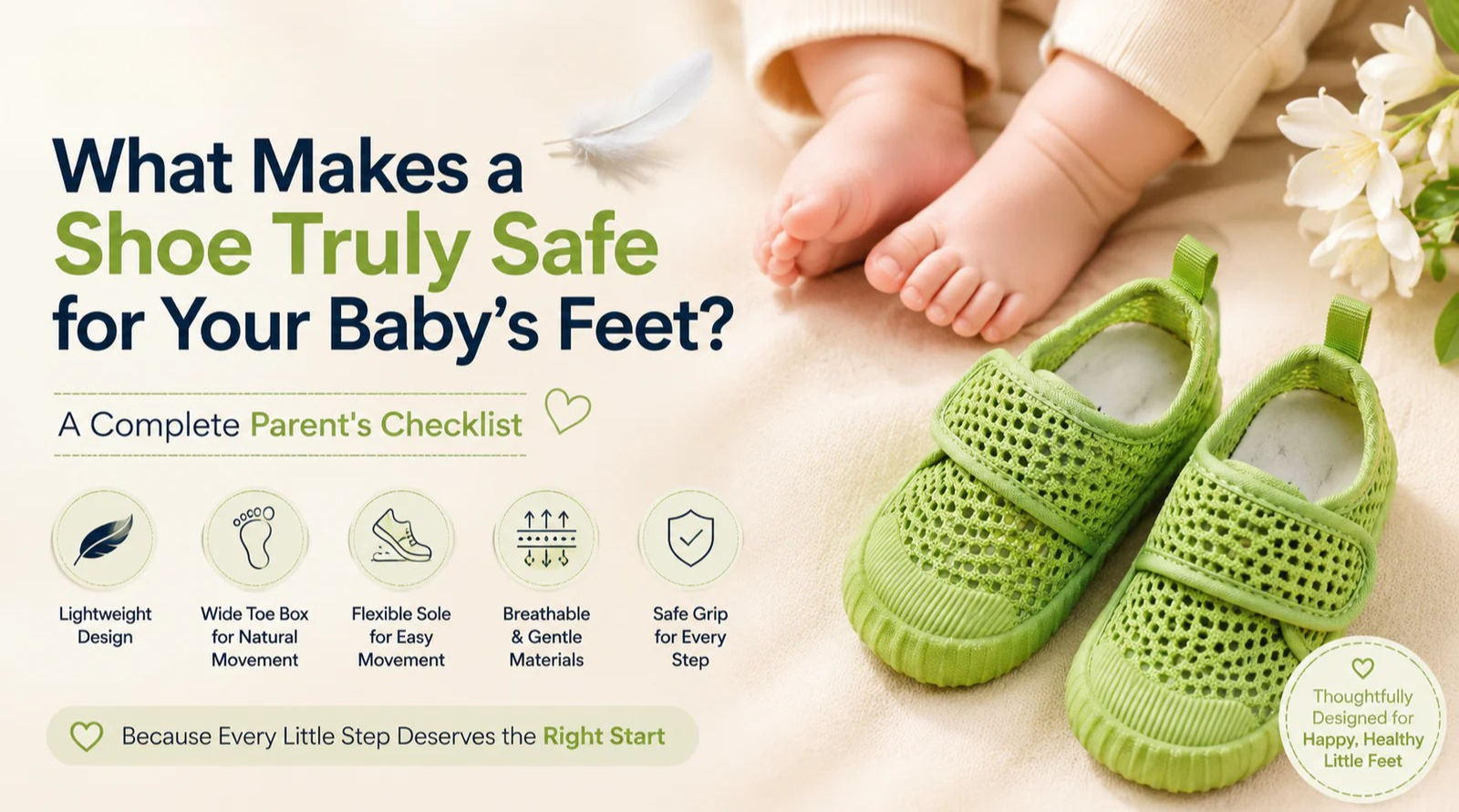
What Makes a Shoe Truly Safe for Your Baby's Feet? A Complete Parent's Checklist
Most parents spend weeks researching prams and car seats. Baby shoes? Usually a five-minute decision based on what looks cute. Here's the problem: between ages one and three, your child's feet are forming their arch, developing balance, and building the muscle memory that affects how they walk for the rest of their life. The shoes on their feet during this window are not a fashion choice, they're a developmental one.
This checklist covers every factor that paediatricians and podiatrists say parents should evaluate before buying shoes for toddlers and first walkers. Save it, share it, and use it every single time.
Why shoe safety matters more than most parents realise
A child's foot at birth is largely cartilage. It doesn't complete its ossification, the process of hardening into bone until around age five or six. During those early years, external pressure from ill-fitting or structurally poor shoes can permanently alter the shape of the foot, affect gait mechanics, and lead to issues that show up much later in life.
Podiatrists who work with children frequently trace adult problems like flat feet, bunions, poor posture, knee pain back to footwear choices made in toddlerhood. The good news: choosing the right shoes is not complicated. It comes down to a handful of clear, checkable criteria. And brands like ONYC have built their entire product philosophy around getting every single one of these right.
The checklist: what to look for before you buy
1. Sole flexibility - the single most important test
Pick up the shoe. Hold the heel in one hand and the toe in the other. Bend it.
A safe shoe for a toddler or first walker should flex easily at the ball of the foot, the widest part, just behind the toes. This is where the foot naturally bends during walking.
-
Good: Bends smoothly at the forefoot with light pressure
-
Bad: Rigid throughout, or bends only in the middle of the arch
Why it matters: stiff soles prevent the foot from completing its natural gait cycle. The foot needs to roll from heel to toe with every step. When a sole blocks that motion, the child compensates often by waddling, toeing out, or lifting the whole foot at once and those compensations create muscle imbalances over time.
This is exactly why ONYC's entire kids' footwear range is built with flexible soles as standard not as a premium add-on, but as the baseline expectation for any shoe designed for a growing foot.
2. Toe box width - give toes room to work
Place the shoe on a flat surface and look at it from above. The widest point of the shoe should match or exceed the widest point of your child's foot typically across the knuckles of the toes.
Toddlers naturally splay their toes when bearing weight. This toe splay is how they balance. A narrow or tapered toe box compresses the toes inward, suppresses natural balance mechanics, and with prolonged wear can affect the developing shape of the foot.
The cardboard test: Trace your child's foot on a piece of cardboard. Cut it out. Slide it into the shoe. If the cardboard buckles or folds at the edges, the shoe is too narrow.
What to avoid: pointed fronts, fashion styles with a tapered silhouette, and any shoe where the child's toes press against the side of the upper when standing. When in doubt, ONYC's size finder helps you find the right width and length combination for your child's specific foot measurements.
3. Toe room (length) - the thumb's width rule
With the shoe on your child's foot and your child standing, press down at the tip of the longest toe. You should feel approximately one thumb's width (about 1 to 1.5 cm) of space between the toe and the end of the shoe.
This growing room allows the foot to move during the push-off phase of walking and accommodates natural growth between fittings.
-
Too tight: Toes touching the front causes nail pressure, blisters, and restricted movement
-
Too loose: More than 1.5 cm of space the foot slides forward, causing instability and blisters at the back
Toddler feet grow approximately one full size every two to three months between ages one and three. Check fit monthly, don't wait until the shoe looks visibly small. ONYC's new arrivals are updated regularly so there's always a fresh option ready when it's time to size up.
4. Heel counter - stability without restriction
Run your thumb around the inside of the heel. The heel counter the firm cup at the back of the shoe should be firm enough to hold the heel centred in the shoe, not so rigid that it digs into the Achilles tendon, and straight when viewed from behind.
A good heel counter prevents the ankle from rolling inward (overpronation), which is especially relevant as children develop their arch through the toddler years. However, it should not lock the ankle full ankle mobility is essential for developing walking mechanics.
5. Sole thickness and heel drop - closer to the ground is better
The best shoes for healthy foot development keep children as close to the ground as possible:
-
Thin soles (4–6mm is ideal for first walkers) that allow sensory feedback from the ground
-
Zero or minimal heel drop the height difference between the heel and forefoot should be as close to zero as possible
Elevated heels shift weight forward, alter posture, and encourage a toe-walking pattern. Thick foam soles that look cushioned and supportive actually reduce the ground feel and proprioceptive feedback children rely on to walk well.
ONYC's first step shoes including the beloved Shady First Step Breathable Shoes keep soles deliberately thin and level so little feet stay in maximum contact with the world beneath them.
6. Weight - if it feels heavy to you, imagine wearing it all day
Toddler shoes should weigh no more than 150 - 180 grams for standard toddler sizes (approximately EU 19-24). Heavy shoes cause early fatigue, shorten walking endurance, and encourage a shuffling rather than lifting gait.
The practical test: hold the shoe in your palm. If it feels substantial, it's too heavy. First walker shoes should feel almost weightless. Pick up any shoe from ONYC's first step range and that lightness is immediately noticeable, it's one of the most consistent things parents comment on in reviews.
7. Upper material - breathability is non-negotiable
For toddlers, breathability is critical, children's feet sweat heavily, and moisture buildup inside a shoe creates friction, blisters, and fungal conditions.
Look for:
-
Canvas or mesh uppers - excellent airflow, lightweight, and generally machine-washable
-
Genuine leather - breathes well, molds to the foot shape over time
-
Avoid: thick synthetic materials, PVC, and heavily padded uppers that trap heat
In India's warm climate, breathability is arguably even more important than in temperate countries. ONYC's breathable first step range is specifically designed for Indian weather conditions, mesh uppers that move air freely and keep feet dry through even the most active days.
8. Closure type - secure, adjustable, and parent-friendly
For toddlers, velcro closures are strongly preferred over laces:
-
They allow precise width adjustment across the instep
-
They create a secure fit that doesn't loosen during active play
-
Children can begin to manage them independently earlier than laces
Slip-on shoes are acceptable for brief outdoor wear but are not recommended as everyday walking shoes. ONYC's boys' shoes and girls' shoes both feature easy velcro and slip-on designs across age groups, worth browsing if you're looking for something that works for both school runs and weekend play.
9. Insole - flat, removable, and not over-cushioned
A good toddler insole should be flat and firm, not thick, not heavily cushioned, and not contoured with an arch support unless prescribed by a podiatrist.
Children's arches develop naturally through walking. Adding an artificial arch support too early can actually interfere with the foot's natural strengthening process. Removable insoles are a practical bonus: they allow you to check fit accurately by placing the insole next to the child's foot.
10. The overall fit check, do it standing, not sitting
Always fit shoes with your child standing, not sitting. The complete standing fit check:
-
Both shoes on, both feet on the floor
-
Check toe room - one thumb's width at the longest toe
-
Check width - no visible bulging at the sides
-
Check heel - finger should slide in snugly but not easily
-
Have the child walk a few steps - watch for any curling of toes, outward rolling of ankles, or changes in their usual gait
If you're ever unsure about sizing between purchases, ONYC's size chart is one of the clearest in the Indian kids' footwear space - measure in centimetres and it maps directly to the right option.
Red flags: shoes to avoid entirely
Even if a shoe passes some checklist criteria, these are automatic disqualifiers:
Rigid plastic soles - found on many fashion and occasion shoes; completely blocks natural foot movement
Pointed or narrow toe boxes - common in dressy styles; compresses toes and disrupts balance
Elevated heels - even 1-2 cm changes posture and gait in developing walkers
Heavy construction - embellishments, thick rubber, multiple layers; tires little feet fast
Pre-worn or hand-me-down shoes - shoes mold to the wearer's foot; wearing another child's shoes imposes their foot shape on your child's developing foot
Non-breathable uppers - anything that visibly traps heat or moisture
Shoes sized up "to last longer" - always buy true to foot with appropriate growing room only; use ONYC's size finder if unsure
What "orthopedic friendly" really means
The term is used loosely in marketing. What it should actually mean for children's shoes: the shoe does not restrict natural movement, does not add corrective elements that haven't been prescribed, and supports the foot's own developmental process rather than substituting for it.
Truly orthopedic friendly kids shoes are, counterintuitively, often the simplest i.e light, flexible, wide, and close to the ground. ONYC's design approach reflects this exactly, no unnecessary structure, no overcorrection, just thoughtfully made footwear that gives growing feet the freedom they need. The foot needs room to develop, not a rigid structure to develop around.
A note on "support" - more is not always better
Parents frequently reach for shoes labelled "extra support" or "high stability," assuming more structure means healthier development. Podiatrists are clear: healthy toddler feet do not need corrective support. They need freedom, flexibility, and appropriate protection.
Shoes with excessive medial arch support, thick midsoles, or ankle-high designs can actually slow down the natural strengthening process by doing the work the foot's own muscles should be doing. For all children with typically developing feet, the goal is simple: shoes designed for growing feet that allow every structure, muscle, tendon, bone, and joint to develop through natural use.
Frequently Asked Questions
What should parents look for in toddler shoes?
Parents should prioritise sole flexibility, toe box width, appropriate length with growing room, breathable uppers, lightweight construction, and a secure closure. Avoid rigid soles, narrow fronts, heavy designs, and elevated heels. ONYC's kids' shoe range is built to meet every one of these criteria.
Are flexible sole shoes better for toddlers?
Yes. Flexible soles allow the foot to move naturally through its gait cycle. Stiff soles restrict movement and can cause compensatory patterns that affect posture and joint development.
What shoes are best for healthy foot development?
Shoes that are lightweight, flexible at the forefoot, wide at the toe box, close to the ground, and made from breathable materials. ONYC's first step range is a strong starting point for Indian parents.
Are orthopedic shoes good for toddlers?
Only if prescribed by a pediatric podiatrist for a specific condition. Most toddlers with typically developing feet need flexible, well-fitting shoes, not corrective footwear.
When should I replace my toddler's shoes?
Check fit monthly. Replace when there is less than half a centimetre of growing room at the toe. Use ONYC's size finder to always pick the right size first time.
How do I know if my toddler's shoes are too tight?
Signs include red marks on the foot after removal, your child resisting wearing the shoes, toe bunching visible through the upper, or a change in gait such as tip-toeing or shuffling.
A truly safe shoe for your toddler is not the most expensive one. It's not the one with the most padding. It's the one that your child's foot barely notices is there — because it moves with the foot, protects without restricting, and stays out of the way of a process that nature has already figured out.
Here's a quick reference to come back to every time you shop:
|
Feature |
What to look for |
|
Sole flexibility |
Bends easily at forefoot |
|
Toe box width |
Matches natural toe splay |
|
Toe room |
1–1.5 cm growing space |
|
Heel counter |
Firm, straight, not rigid |
|
Sole thickness |
Thin, minimal heel drop |
|
Weight |
Under 180g for toddler sizes |
|
Upper material |
Breathable: canvas, mesh, leather |
|
Closure |
Velcro preferred |
|
Insole |
Flat, not over-cushioned |
|
Overall fit |
Checked standing, not seated |
Every step your toddler takes is building something. ONYC exists because a team of parents decided that Indian kids deserved footwear designed around this exact checklist, not around what looks impressive on a shelf. Browse their full kids' shoe collection, explore bestsellers that thousands of Indian parents have already tested and loved, and use the size finder to get the fit right from day one. Because comfort for tiny feet and a healthy start for little feet isn't a bonus feature, it's the whole point.