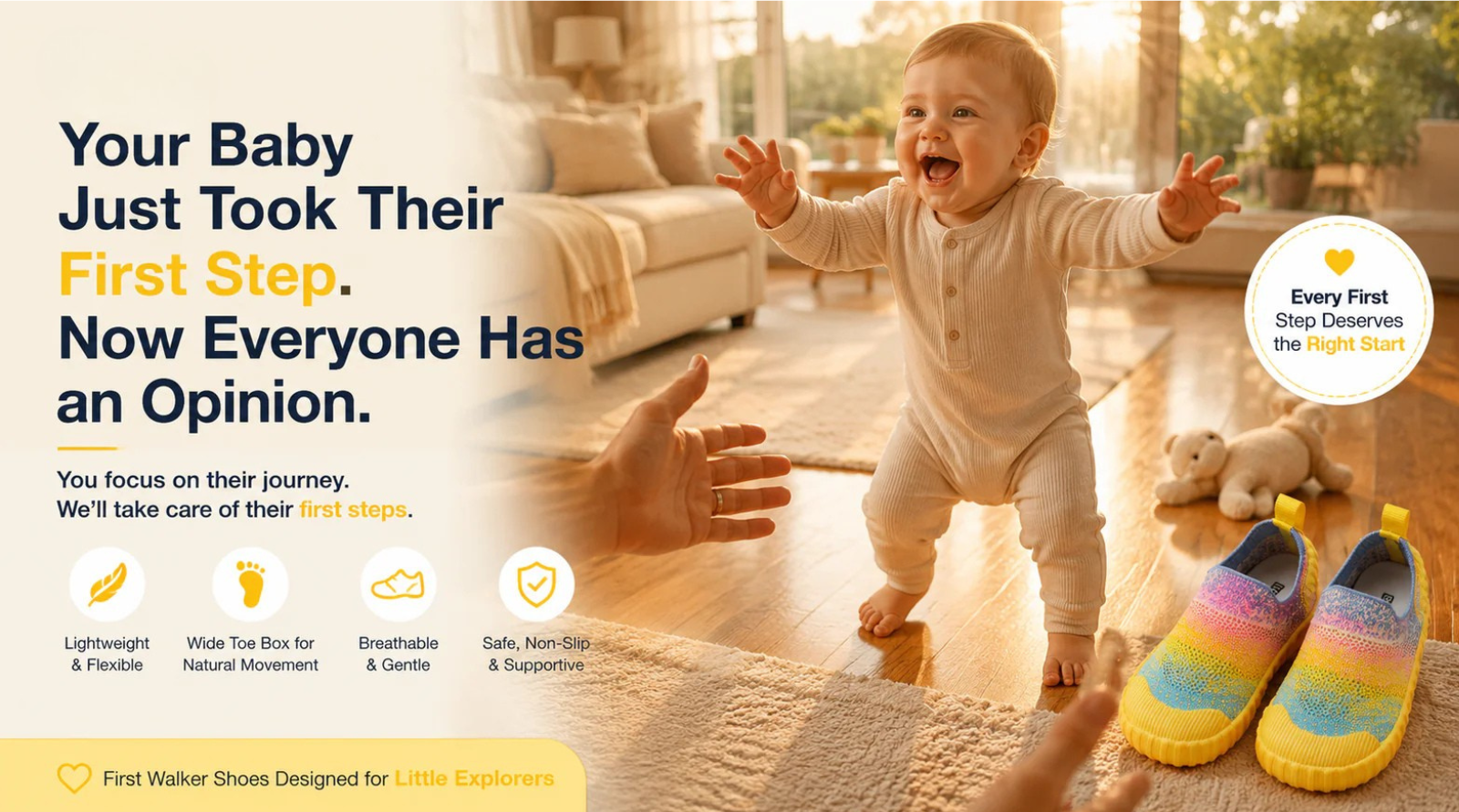
Your Baby Just Took Their First Step. Now Everyone Has an Opinion
Your mother says shoes are essential babies need support. Your sister says go barefoot that's how nature intended it. Your paediatrician mentioned something about "flexible soles." And somewhere on Instagram you saw a reel about how shoes could actually harm your toddler's feet.
Who's right?
Here's the thing: this isn't actually a debate with two equal sides. The science is surprisingly clear and the answer isn't fully barefoot *or* fully shod. It's more nuanced than that, and getting it right in those early walking months genuinely matters for how your child's feet, posture, and gait develop for the rest of their life.
Let's break it all the way down.
What Happens to Feet During the First Three Years
To understand the barefoot debate, you need to understand what a baby's foot actually is, because it is fundamentally different from an adult's.
A newborn's foot contains *no true bone*. What looks like a foot is mostly cartilage which is soft, pliable, highly malleable tissue that gradually calcifies into 26 bones over the first several years of life. By age 3, the foot is still only partially ossified. By age 6-7, the arch is still developing. Full foot maturity doesn't happen until the late teens.
This is why the choices you make in those early years carry weight. The footwear (or lack of it) that surrounds a developing foot during these critical windows either supports healthy bone and muscle formation or interferes with it.
Here's what child development and orthopedic research consistently shows happens during the first three years:
0-9 months : No walking, no shoes needed. Period. Socks for warmth, nothing more.
9-15 months : The pulling-up and cruising phase. Babies begin bearing weight. Barefoot is still ideal on safe indoor surfaces the tactile feedback from the floor helps the brain map the body and develop balance.
12-18 months : Most babies take their first independent steps somewhere in this window. This is the stage where the barefoot vs. shoes question becomes real.
18 months-3 years : Walking becomes running, climbing, and jumping. The foot is working hard. The right footwear matters enormously here.
The Case for Barefoot: What the Research Actually Shows
Paediatricians and podiatrists have been studying barefoot walking in children since the 1990s, and the findings are remarkably consistent. Barefoot is developmentally superior on safe, appropriate surfaces.
Here's why:
1. Sensory Input Shapes How the Brain Learns to Walk
The sole of a baby's foot is covered in proprioceptive nerve endings, sensory receptors that relay information about surface texture, temperature, and pressure to the brain. This feedback is what allows the brain to build a map of the body and develop balance, coordination, and gait.
When a thick, rigid sole is placed between the foot and the ground, that sensory input is muted. The brain receives a less detailed signal. Balance development can be slower, and compensatory walking patterns can emerge.
A 2018 study published in *Scientific Reports* found that children who spent more time barefoot had significantly better balance and motor performance than those in shoes. The barefoot children also showed more advanced jumping and balance skills.
2. Barefoot Builds Stronger Foot Muscles
Shoes, especially overly structured ones do the muscular work of stabilising the foot *for* the child. The arch muscles, toe muscles, and ankle stabilisers don't have to engage as fully. Over time, this can lead to weaker intrinsic foot muscles and a higher risk of flat feet.
Children who grow up in barefoot-friendly cultures show significantly lower rates of flat feet and foot deformities compared to children in heavily shoe wearing cultures. A landmark 1992 study by Dr. Lynn Staheli, one of the most cited paediatric orthopaedic surgeons in history found that flat feet and foot problems were more common in people who wore shoes during childhood than in those who went barefoot.
3. It Supports Natural Arch Development
The arch of the foot is not present at birth. It develops through the activation of intrinsic foot muscles during walking. Heavy, rigid shoes that "support" the arch before it has developed can actually impede this natural process because the muscles that are supposed to build the arch never get adequately stimulated.
Barefoot walking lets those muscles work, develop, and form the arch naturally over time.
But Barefoot Isn't Always the Answer
Before you throw out every pair of toddler shoes in the house, here's the critical nuance the research also makes clear:
Barefoot is best in safe, indoor environments.
The moment your child steps outside, onto hot pavement, uneven terrain, a beach, a market floor or basically any real-world Indian surface the equation changes entirely.
Outdoor environments present risks that bare feet are not equipped for:
-Sharp objects: glass, stones, thorns, metal
-Hot surfaces:asphalt and concrete in Indian summer can exceed 60°C
-Rough or uneven terrain:gravel, cobblestones, and uneven paths require protection
-Infection risk:particularly relevant on Indian streets and public areas
-Hygiene concerns:public play areas, shopping centres, and parks
The goal, as most child development experts frame it, is not "barefoot vs. shoes" it's "barefoot-like shoes for outdoors." That is, footwear that protects from environmental hazards while minimising interference with the natural movement and sensory feedback of the foot.
What "Barefoot-Like" Shoes Actually Means
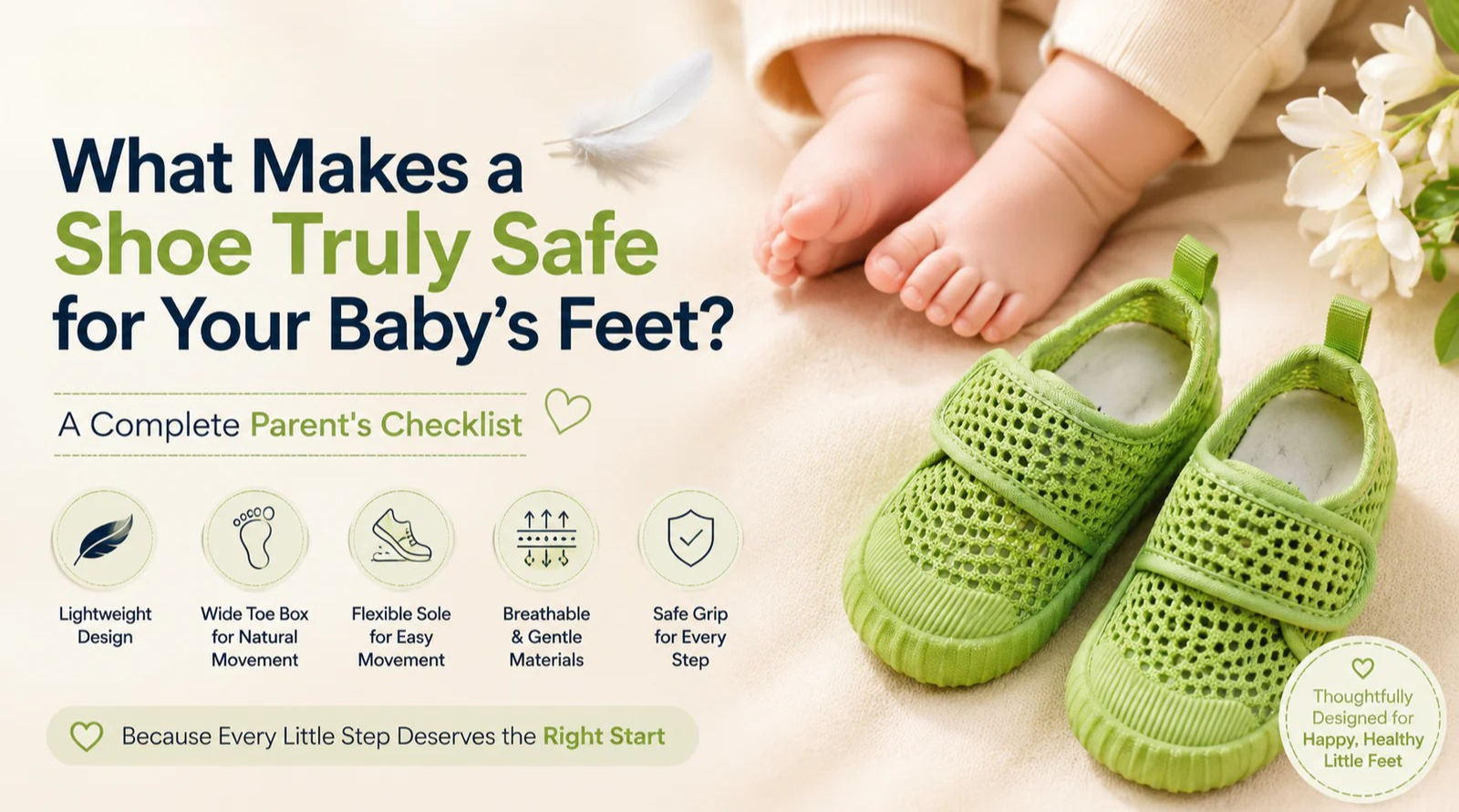
When paediatricians and podiatrists recommend "barefoot-like" or "minimal" shoes for first walkers, they're describing a specific set of characteristics and not a brand, not a style, but a functional standard:
1.Flexible Sole
The single most important feature. The sole should bend easily at the ball of the foot the same point where the foot naturally flexes during walking. A simple test: hold the shoe at the toe and heel and try to bend it. It should fold easily. If it resists, it's too rigid for a first walker.
2.Thin Sole with Ground Feel
A thinner sole allows more sensory feedback from the ground closer to the barefoot experience. It shouldn't be paper-thin (protection is still needed), but it shouldn't be so thick and cushioned that the child can't feel the surface they're walking on.
3.Wide Toe Box
Baby feet are widest at the toes. Shoes that narrow at the front compress the toes, restrict natural splay, and can create pressure points that affect how the child walks. The toe box should be wide enough for toes to spread naturally with each step.
4.Lightweight
A heavy shoe on a tiny foot changes gait mechanics. The child has to lift more weight with each step, which alters muscle activation patterns and can cause fatigue and compensatory movement. The lighter the shoe, the less it interferes.
5.No Raised Heel
Adult shoes typically have a raised heel that shifts weight forward onto the ball of the foot. For a first walker, this is disruptive, as babies need to feel the full length of the foot in contact with the ground. A flat or near-flat profile is developmentally appropriate.
6.Secure Fastening
Velcro or adjustable straps that keep the shoe firmly on the foot without the child having to grip their toes to hold the shoe on (as happens with loose slip-ons). Toe-gripping causes abnormal muscle tension.
7.Breathable Upper
Children's feet sweat more per square centimetre than adults'. A breathable fabric or mesh upper keeps the foot dry, comfortable, and prevents the skin issues that come with trapped moisture.
The ONYC Standard: Built Around This Science
This is exactly the design philosophy that ONYC was built on. India's No. 1 award winning kids footwear brand, ONYC designs shoes with the biomechanical reality of developing feet at the centre of every decision not aesthetics, not fashion trends, not adult shoe conventions scaled down.
Every pair is engineered to be:
- Soft and flexible - not stiff, not heavy
- Wide at the toe - to allow natural toe splay
- Lightweight - to preserve natural gait
- Breathable - for the Indian climate
- Designed for real play - because that's what children actually do
Browse the ONYC First Step Shoes collections designed specifically for babies and toddlers in their first walking phase.
For girls: Girls Shoes
For boys: Boys Shoes
The Most Common Shoe Mistakes Parents Make for First Walkers
Buying "Supportive" Shoes Too Early
Arch support, rigid soles, and ankle stability features are designed for feet that have already developed some structure. Applying them to a 12-month-old who is still building that structure can actually impede development. First walker shoes should be flexible, not "supportive" in the adult sense.
Buying Shoes to "Grow Into"
Shoes that are even half a size are too large because toe gripping the child unconsciously curls their toes to keep the shoe from slipping off. This creates abnormal muscle tension and affects gait. Fit the shoe to the foot right now, not to next year's foot. ONYC recommends checking fit every 2–3 months for fast-growing feet.
Choosing Based on Looks Over Feel
The cutest shoe in the shop may have the most rigid sole. Always test: bend the sole at the ball of the shoe. If it doesn't flex easily, it's not right for a first walker regardless of how adorable it is.
Keeping Shoes On All Day
Even in the correct shoes, children benefit from time barefoot every day. Unstructured barefoot time on safe indoor surfaces continues to build strength and proprioception throughout the early years. Shoes are for going out, not for staying in.
Skipping the Size Check
Indian parents often buy imported shoes based on age labels "12 months" "2 years" without measuring actual foot length. Sizing varies significantly between brands and countries. Always measure the child's foot length and use a brand's specific size chart. ONYC offers a detailed [kids footwear size chart](https://onyc.in/) for accurate Indian sizing.
Frequently Asked Questions
Q: Should babies learn to walk barefoot or with shoes?
Barefoot is best on safe, clean indoor surfaces the sensory feedback builds balance and strength. Shoes become necessary outdoors, but should be soft, flexible, and lightweight to mimic barefoot movement.
Q: At what age should babies start wearing shoes?
Only once they start walking outdoors, typically between 12 and 18 months. Before that, bare feet or soft socks indoors are all that's needed.
Q: Can shoes damage my baby's foot development?
Stiff, heavy, or poorly fitted shoes can interfere with natural foot development by restricting toe splay, muting sensory feedback, and inhibiting the muscles that form the arch. Flexible, well-fitted shoes do not they protect while preserving natural movement.
Q: What kind of shoes are best for first walkers?
Flexible soled, lightweight, wide at the toe, with a flat or near-flat profile and a secure fastening. These characteristics allow the shoe to protect the foot while keeping movement as close to barefoot as possible.
Q: Is it okay for toddlers to go barefoot at home?
Yes, paediatricians actively encourage barefoot time at home on clean, safe surfaces throughout the early childhood years. It builds strength, coordination, and proprioception.
Q: How do I know if my toddler's shoes fit correctly?
There should be approximately 1cm of space beyond the longest toe. The heel should be snug without slipping. Toes should not be visibly compressed or bulging at the sides. If the child seems to grip with their toes, the shoe may be too loose.
Q: Do toddlers need arch support in their shoes?
No, not for the first few years. The arch is still forming through muscle activation during barefoot and near-barefoot movement. Premature arch support can prevent the muscles that build the arch from developing properly.
Barefoot vs. Shoes: The Verdict
The barefoot movement is right about the fundamentals: bare feet on safe surfaces are developmentally ideal and should be prioritised at home throughout early childhood.
But barefoot-only is not realistic, not safe, and not necessary. The goal is to extend the benefits of barefoot walking into real-world environments through shoes that mimic, rather than override, natural foot function.
That means flexible soles. Wide toe boxes. Light weight. Minimal heel. Breathable materials. A fit that's snug but not restrictive.
It means shoes designed for the foot your child has not the foot an adult shoe designer imagined.
Explore the full range of first walker and toddler shoe at ONYC India's most trusted kids footwear brand, built on exactly this science.