How to Measure Your Child's Shoe Size at Home (+ ONYC Size Guide for Indian Kids)
Every parent has been there you order what seems like the perfect pair of shoes online, they arrive looking adorable, and then your child tries them on and they are either too tight or too loose. With kids' feet growing rapidly, getting the size right is one of the most important and most overlooked parts of buying children's footwear.
The good news? You do not need a fancy shoe store or professional equipment to measure your child's foot correctly. With a few simple tools you already have at home, you can get an accurate measurement every time.
This guide walks you through the step-by-step process of measuring your child's shoe size at home, explains how Indian sizes compare to UK and EU sizes, and gives you a complete age-wise size guide for reference.
Why Getting the Right Shoe Size Is So Important
Children's feet are not just small, they are structurally different from adult feet. The bones are still largely cartilage, making them soft, flexible, and easy to mould. This is great for natural development, but it also means that ill-fitting shoes can cause lasting harm if worn over a prolonged period.
Shoes that are too small can cause:
-
Blisters, ingrown toenails, and skin irritation
-
Toes being pushed into unnatural positions
-
Long-term toe deformities
Shoes that are too large can cause:
-
Tripping and falls
-
Incorrect walking patterns and posture
-
Excessive friction and blisters from sliding
Getting the right size protects your child's feet during the most important years of development.
What You Will Need
-
A plain sheet of white paper (A4 size works perfectly)
-
A pencil or pen
-
A ruler or measuring tape
-
Good lighting
-
Your child's cooperation (tip: make it a fun activity!)
Step-by-Step: How to Measure Your Child's Foot at Home
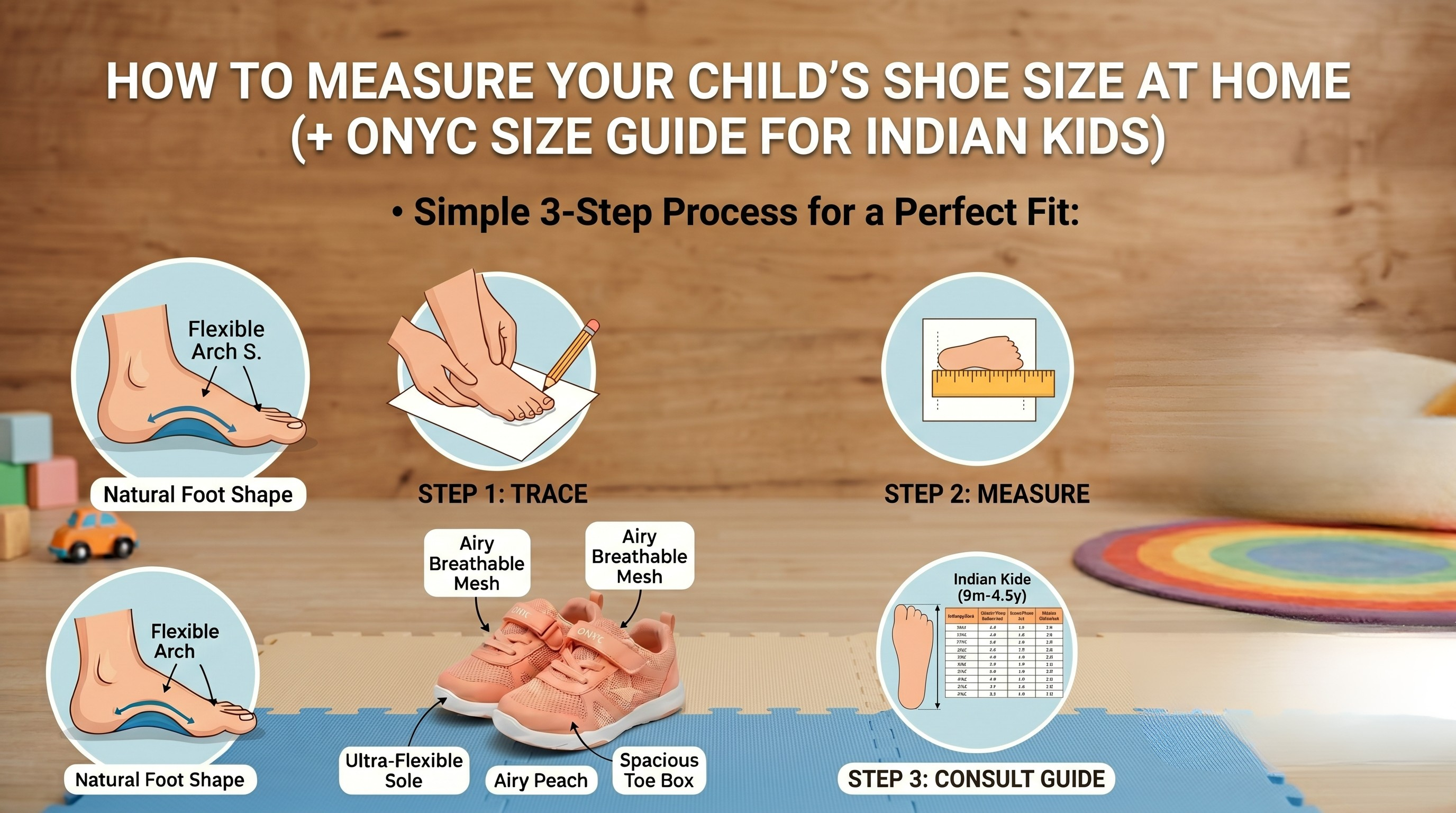
Step 1: Choose the Right Time of Day
This matters more than most parents realise. Feet naturally swell slightly throughout the day. Measure your child's feet in the afternoon or evening, not first thing in the morning for the most accurate measurement.
Step 2: Have Your Child Stand on the Paper
Place the sheet of paper on a hard, flat floor not carpet. Have your child stand with their full weight on the foot you are measuring. Sitting measurements are less accurate as the foot does not flatten out the same way.
Step 3: Trace the Foot
Hold the pencil vertically (not at an angle) and carefully trace around the entire foot, keeping the pencil as close to the foot as possible. For younger toddlers and babies, you may need a second person to help keep the child still.
Step 4: Measure the Tracing
Once you have the tracing, use your ruler to measure two things:
Length: Measure from the tip of the longest toe (usually the big toe, but not always) to the back of the heel. This is the key measurement for shoe sizing.
Width: Measure the widest part of the foot tracing. This helps you determine if your child needs a standard or wide-fit shoe.
Step 5: Repeat for Both Feet
It is completely normal for one foot to be slightly larger than the other. Always measure both feet and use the larger measurement when selecting shoe size.
Step 6: Add the Growing Room
Once you have your measurement in centimetres, add 1-1.5 cm to allow for growing room and natural movement inside the shoe. This is your target shoe size in cm.
How to Convert Your Measurement to Indian / UK / EU Shoe Sizes
Shoe sizing in India generally follows the UK sizing system. Here is how centimetre measurements convert across sizing systems:
Kids' Shoe Size Chart (Infant & Toddler — 0 to 4 Years)
|
Foot Length (cm) |
India / UK Size |
EU Size |
US Size |
|
9.5 cm |
1 |
17 |
1.5 |
|
10.2 cm |
2 |
18 |
2.5 |
|
11.0 cm |
3 |
19 |
3.5 |
|
11.7 cm |
4 |
20 |
4.5 |
|
12.3 cm |
5 |
21 |
5.5 |
|
13.0 cm |
6 |
22 |
6.5 |
|
13.7 cm |
7 |
23 |
7.5 |
|
14.3 cm |
8 |
24 |
8.5 |
|
15.0 cm |
9 |
25 |
9.5 |
|
15.7 cm |
10 |
26 |
10.5 |
Kids' Shoe Size Chart (Junior — 4 to 10 Years)
|
Foot Length (cm) |
India / UK Size |
EU Size |
US Size |
|
16.3 cm |
11 |
28 |
11.5 |
|
17.0 cm |
12 |
29 |
12.5 |
|
17.7 cm |
13 |
31 |
1 |
|
18.3 cm |
1 (Junior) |
32 |
1.5 |
|
19.0 cm |
2 (Junior) |
33 |
2.5 |
|
19.7 cm |
3 (Junior) |
34 |
3.5 |
|
20.3 cm |
4 (Junior) |
35 |
4.5 |
|
21.0 cm |
5 (Junior) |
36 |
5.5 |
Note: Sizing can vary slightly between brands. Always refer to the specific brand's size chart for the most accurate fit.
For ONYC's detailed size chart, visit: onyc.in/pages/size-chart-shoes
Age-Wise Shoe Size Guide for Indian Kids
While every child grows at their own pace, this general reference can be a helpful starting point:
|
Age |
Average Foot Length |
Approximate India / UK Size |
|
0–3 months |
9–10 cm |
1–2 |
|
3–6 months |
10–11 cm |
2–3 |
|
6–12 months |
11–12 cm |
3–4 |
|
12–18 months |
12–13 cm |
4–6 |
|
18 months–2 years |
13–14 cm |
6–8 |
|
2–3 years |
14–15 cm |
8–9 |
|
3–4 years |
15–16 cm |
9–11 |
|
4–5 years |
16–17 cm |
11–12 |
|
5–6 years |
17–18 cm |
12–13 |
|
6–8 years |
18–20 cm |
1–3 (Junior) |
|
8–10 years |
20–22 cm |
3–5 (Junior) |
Remember: These are averages. Always measure and use the actual foot length for accurate sizing.
How Often Should You Measure Your Child's Feet?
Children's feet grow faster than most parents expect. Here is a general guideline:
-
Under 1 year: Measure every 6-8 weeks
-
1–3 years: Measure every 2-3 months
-
3–5 years: Measure every 3-4 months
-
5 years and older: Measure every 4-6 months
As a practical rule, if your child has been wearing the same pair for more than 3 months, check the fit before assuming they still fit correctly.
5 Signs Your Child Has Outgrown Their Shoes
Sometimes children do not tell you their shoes are too tight (especially younger toddlers who cannot communicate discomfort clearly). Watch for these signs:
-
Red marks or blisters on the toes, sides, or heels after wearing
-
Toes pressing against the front of the shoe i.e visible bumping at the toe box
-
The child walks differently like limping, walking on tiptoe, or resisting putting shoes on
-
Difficulty putting the shoe on without forcing
-
The shoe looks misshapen or stretched out at the sides
Tips for Buying Kids' Shoes Online in India
Buying kids' shoes online in India is convenient but comes with the challenge of not being able to try before you buy. Here is how to shop smart:
Always measure first. Never guess based on age alone. Follow the steps above and use the size chart.
Check the brand's specific size chart. Sizing can vary between brands. ONYC's size guide at onyc.in/pages/size-chart-shoes gives precise measurements mapped to their collections.
Read the return policy. Even with accurate measuring, sometimes a pair does not fit correctly. ONYC offers a 7-day hassle-free return or exchange so you can shop with confidence.
Check customer reviews for fit notes. Many buyers mention whether a shoe runs large or small. These notes are invaluable when buying online.
ONYC's Size Guide for Indian Kids
At ONYC, we know that sizing is one of the biggest concerns for parents shopping online. That is why we have created a detailed, easy-to-use size chart that maps foot length in centimetres directly to ONYC shoe sizes across all our collections from first step shoes to sandals and flip-flops.
Our shoes are designed for Indian feet which means comfortable width, adequate toe room, and sizing that genuinely reflects how Indian children's feet are shaped.
View ONYC's Complete Size Chart: onyc.in/pages/size-chart-shoes
Frequently Asked Questions
Q1. How do I measure a newborn's foot size?
Lay your newborn on a flat surface, gently press their foot down onto paper, and trace it. Newborns often curl their toes, so make sure the foot is relaxed before tracing. Measure the length from heel to longest toe.
Q2. My child's two feet are different sizes — which size should I buy?
Always buy for the larger foot. A shoe that is slightly large on one foot is far more comfortable than a shoe that is too tight on the other.
Q3. How much growing room should I leave in a kids' shoe?
A thumb's width (approximately 1–1.5 cm) of space between the longest toe and the front of the shoe is the ideal amount.
Q4. Can I buy kids' shoes online in India with easy returns?
Yes. ONYC offers a 7-day hassle-free return and exchange policy. Visit onyc.in to explore our full range of kids' footwear delivered across India.
Q5. My toddler refuses to stand still for measuring. What do I do?
Try the tracing method while your child is distracted with a toy or snack. For very young babies, you can gently press their relaxed foot flat and trace it while they are calm or sleepy.
Final Thoughts
Measuring your child's shoe size at home takes less than five minutes but it can make the difference between a pair of shoes that your child loves and one that causes discomfort or gets discarded after a week.
Make it a habit to measure every few months, keep track of the measurements, and always refer to the brand's size chart before placing an order.
At ONYC, we are committed to making the shoe-buying experience as smooth as possible for Indian parents. From our detailed size guide to our hassle-free returns, we take the guesswork out of getting the right fit.
View Size Chart | Shop Boys' Shoes | Shop Girls' Shoes | Shop All