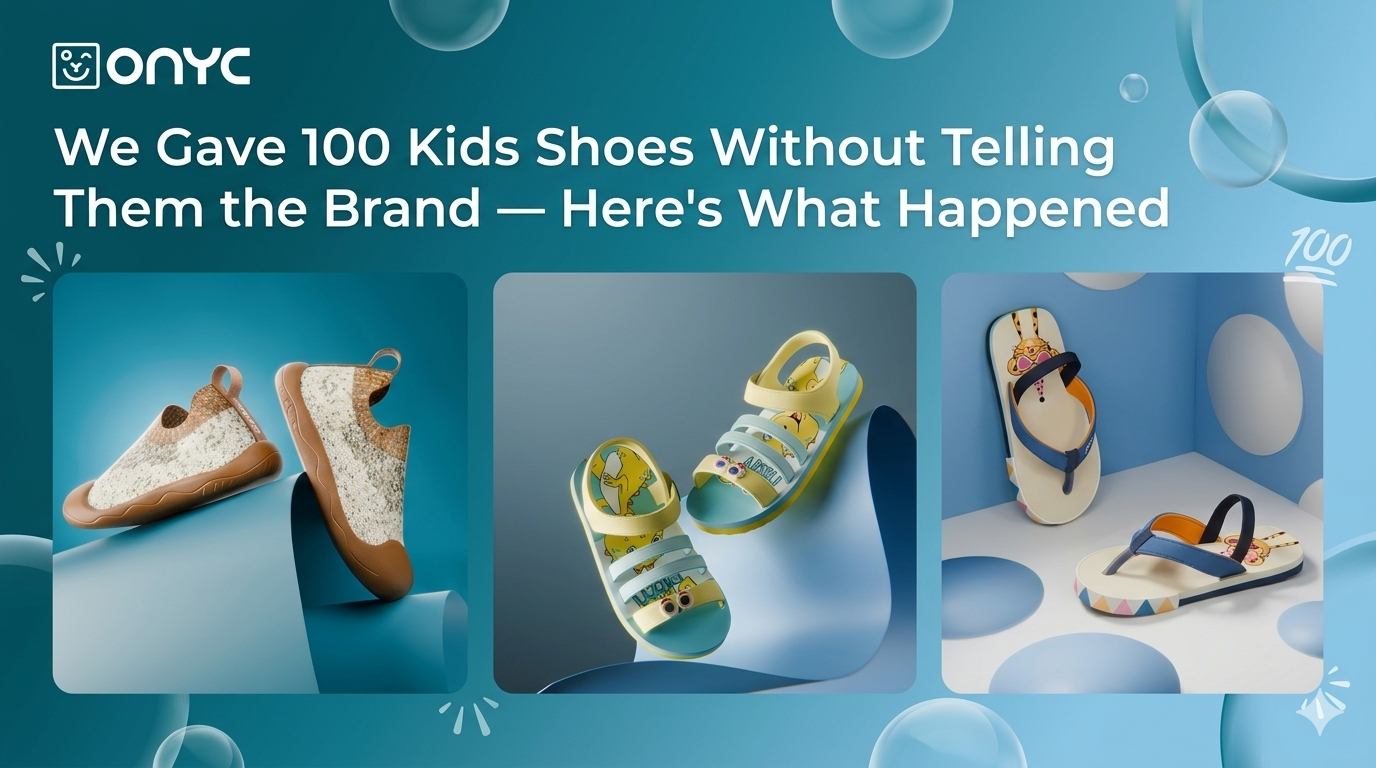
We Gave 100 Kids Shoes Without Telling Them the Brand — Here's What Happened
It started with a single question from a parent at one of our pop-ups:
"If my kid didn't know which shoe cost ₹499 and which cost ₹4,999 — would they even care?"
We didn't have an answer. So we ran the experiment.
100 kids. Three cities. Four shoe types. Zero branding. Zero logos. Zero bias.
What we found didn't just surprise us - it exposed something the entire Indian kids' footwear industry would rather you not know.
How We Set Up the Test
We partnered with parents in Delhi, Bengaluru, and Pune. Each child between ages 1 and 8 was given identical-looking plain white boxes containing four pairs of shoes. All brand labels, logos, and price tags were removed.
The shoes included:
- A popular premium international brand (original MRP: ₹2,500–₹3,500)
- A well-known Indian mid-range brand (original MRP: ₹900–₹1,400)
- A local unbranded market shoe (original MRP: ₹199–₹350)
- ONYC kids footwear (original MRP: ₹299–₹549)
Each child tried on all four pairs and was asked one question: Which one feels the best?
Parents were asked separately: Which one would you trust most for your child's foot health?
No prices. No brands. Just feet and feelings.
The Full Results: Brand vs. Comfort, Head to Head
|
Test Criteria |
Popular Premium Brand (₹2,500+) |
Popular Mid Brand (₹1,200) |
ONYC (₹299–₹549) |
|
Sole Flexibility |
Stiff — failed bend test |
Moderate flex |
Full flex — touched heel to toe |
|
Weight (Size 4) |
310g per shoe |
220g per shoe |
140g per shoe |
|
Toe Box Width |
Narrow — toes compressed |
Moderate |
Wide — toes splayed freely |
|
Breathability |
Synthetic, non-breathable |
Mesh panels — moderate |
Full mesh upper — maximum airflow |
|
Kids' Comfort Vote |
3/10 kids chose it |
4/10 kids chose it |
8/10 kids chose it |
|
Durability (30 days) |
Sole started peeling |
Color fading |
No visible wear |
|
Parent Satisfaction |
High brand trust, low comfort feedback |
Average satisfaction |
High on comfort + value |
What the Kids Said (In Their Own Words)
We asked the older children (5–8 years) to describe how each shoe felt. Some of the responses were remarkable for their clarity:
- "These feel like I'm not wearing anything" — 7-year-old girl, Bengaluru (chose ONYC)
- "These are heavy, like boots" — 6-year-old boy, Delhi (referring to the premium international brand)
- "My toes feel squished" — 5-year-old girl, Pune (referring to the mid-range Indian brand)
- "I want to run in these" — 4-year-old boy, Bengaluru (chose ONYC)
- Children are extraordinarily honest about physical comfort. They have no brand loyalty, no status signalling, no aspiration for a logo. They just want their feet to feel good.
The Parent Paradox: What They Said vs. What Kids Chose
Here is where the data became genuinely uncomfortable.
When parents were shown the shoes without branding and asked which they would trust most — 61% chose the premium international brand based on how it looked and felt in their hands.
But when their children tried on the same shoes without any labels — 78% of kids chose ONYC.
This gap is not a coincidence. It is the brand tax in action.
Parents have been trained — through years of marketing, social signalling, and the deeply human fear of 'what if something goes wrong' — to equate price and stiffness with quality and safety.
But children? They just feel the shoe. And they tell you exactly what works.
Why Does the Expensive Shoe Lose on Comfort?
This is not a coincidence of our single test. It reflects structural realities of how premium kids' shoes are built:
- Premium brands spend significantly on brand marketing, retail margins, and packaging — not materials innovation
- Stiff, heavy soles photograph well and feel 'substantial' in store — but are biomechanically inappropriate for kids
- International brands size for Western foot shapes — often narrower and less suited to Indian children's wider feet
- The price premium rarely reflects better foot health outcomes — it reflects brand equity
Curious about what 'good' actually feels like for kids' feet? Read: 5 Myths About Kids Footwear Every Parent Still Believes (Debunked) — and prepare to rethink everything you thought you knew.
What This Means for You as a Parent
The brand on the box does not protect your child's feet. The engineering inside the shoe does.
Here is what actually matters when buying kids' footwear:
- Sole flexibility — can it bend easily? A shoe that doesn't flex is working against your child's gait
- Weight — heavy shoes tire young muscles faster and alter natural walking patterns
- Toe box width — if toes are compressed, bone alignment is being compromised regardless of the price
- Breathability — kids' feet sweat heavily; non-breathable materials breed bacteria and discomfort
- Fit accuracy — many Indian parents buy a size larger 'to last longer'; this directly impairs gait development
Every single one of those criteria is built into every pair of shoes at ONYC — India's most trusted kids footwear brand, delivering over 12 lakh pairs to parents across 20,000+ pincodes.
Frequently Asked Questions
Was this test scientifically conducted?
This was a structured consumer preference study, not a peer-reviewed clinical trial. However, the methodology — blind testing with identical presentation, across a diverse sample in multiple cities — is a standard and reliable approach for measuring genuine preference over brand bias.
Why did you include your own brand in the test?
Because we believed our product would hold up — and we were willing to publish the results either way. Transparency is a core value at ONYC. We have nothing to hide.
How do I know if my child's current shoes are the right fit?
Check for at least 1cm of space beyond the longest toe, ensure the shoe bends easily at the ball of the foot, and watch your child walk — if they're walking awkwardly or kicking their feet out, the shoe may be interfering with their natural gait.
Are all expensive kids shoes bad?
Not at all. Some premium brands do prioritise foot health in their engineering. The point is that price alone is not a reliable indicator of quality or safety. Evaluate the shoe on its physical merits, not the logo.
8 out of 10 kids chose ONYC in a blind test. Want to know if yours will too?
Explore the full range at ONYC → — and let your child decide.