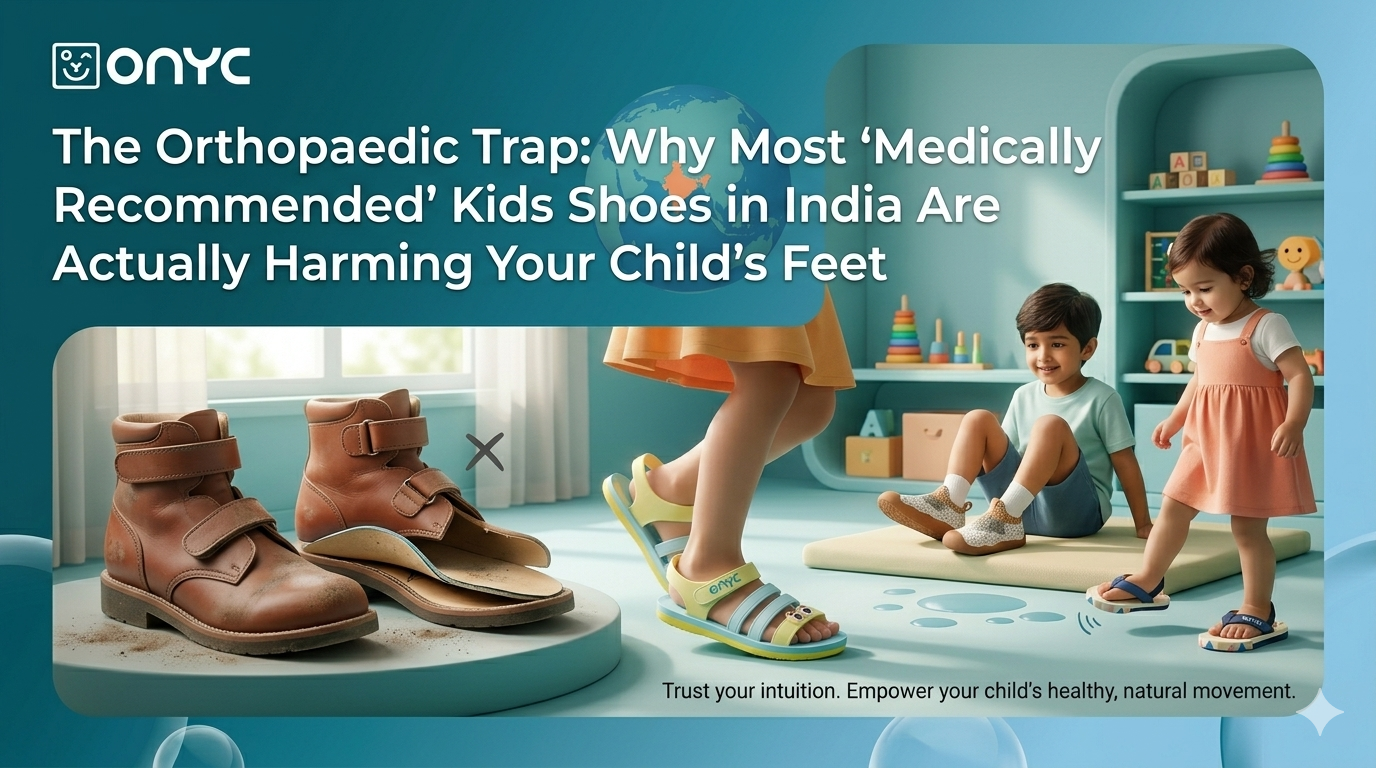
The Orthopaedic Trap: Why Most 'Medically Recommended' Kids Shoes in India Are Actually Harming Your Child's Feet
You walked into the store. The salesperson pointed at the stiff, thick-soled shoe and said:
"Doctor-recommended. Great for growing feet. Supports the arch."
You bought it. Because of course you did — you're a good parent.
But what if that exact shoe — the one sitting on your child's feet right now — is quietly undoing what nature is trying to build?
This isn't a scare story. This is what paediatric biomechanics research has been saying for over a decade, and almost no kids footwear brand in India is talking about it.
Until now.
First, Let's Talk About What's Actually Happening Inside Your Child's Foot
A child's foot at birth is not a miniature adult foot. It is made almost entirely of soft cartilage — flexible, unformed, waiting to be shaped by movement.
Between ages 0 and 4.5, the foot goes through its most critical development phase. The bones harden, the arch forms, the muscles strengthen — but only if the foot is allowed to move freely and naturally.
Here is the uncomfortable truth: stiff, structured shoes don't support this process. They interrupt it.
When a shoe forces the foot into a fixed position — rigid sole, locked ankle, tight toe box — the small intrinsic muscles of the foot have no reason to activate. They don't get stronger. The arch doesn't develop through natural loading. The child's body doesn't learn to balance, pronate, and adapt.
It simply sits inside the shoe and waits.
The 'Orthopaedic' Label: What It Really Means (And What It Doesn't)
The word 'orthopaedic' has been doing a lot of heavy lifting in the Indian kids' footwear market.
For most parents, orthopaedic = medical = safe = correct. It's a shortcut. And brands know it.
But here's what the American Academy of Pediatrics actually concluded in their footwear guidelines:
Healthy children do not need arch support, corrective shoes, or special insoles unless specifically prescribed by a doctor for a diagnosed condition.
The flat foot you see in your toddler? That's not a problem. That's normal anatomy. Most children develop their arch naturally between ages 3 and 6 — without any 'correction' at all.
What does require correction is forcing a developing foot into a rigid structure that prevents it from doing its job.
The Comparison: What Brands Claim vs. What Research Shows
Here's a breakdown of the most common 'orthopaedic' features marketed to Indian parents — and what they actually do to a child's developing foot:
|
Shoe Feature |
What Brands Say |
What Research Says |
ONYC Approach |
|
Arch Support |
Essential from day 1 |
Children under 6 don't need it — feet are flat by design |
Zero forced arch — natural foot shaping |
|
Hard/Rigid Sole |
Protects and corrects |
Restricts natural flexion, weakens intrinsic muscles |
Ultra-flexible sole that bends with every step |
|
Heavy Structure |
Provides stability |
Extra weight fatigues growing muscles faster |
Lightweight build — feet barely know it's there |
|
Ankle Locks |
Prevents rolling |
Limits ankle proprioception development |
Free ankle movement for natural gait |
|
Tight Toe Box |
Neat fit, no sliding |
Compresses toes, disrupts bone alignment |
Wide toe box — toes can splay naturally |
Why Is This Happening? The Uncomfortable Business Reality
Stiff shoes cost more to market. They look more serious. They feel more substantial in your hand when you pick them up in the store. They command a higher price point.
Soft, flexible, lightweight shoes? They feel 'cheap' to the uninformed buyer — even when they're infinitely better for the child's foot.
This is why most Indian kids' footwear brands have no incentive to educate you. The more scared you are about your child's feet, the more you spend.
So What Should a Healthy Kids' Shoe Actually Look Like?
Based on paediatric podiatry research and biomechanical studies, here's what genuinely supports healthy foot development:
- Flexible sole that bends easily with the foot's natural motion
- Wide toe box — toes must be able to splay and grip
- Lightweight construction — less than 200g per shoe for toddlers
- Breathable upper — children's feet sweat significantly more than adults
- Minimal heel elevation — flat or near-flat base for natural gait development
- Secure but non-restrictive fit — stable without clamping
This is exactly the design philosophy behind every pair at ONYC — India's award-winning kids footwear brand built by parents, for parents. Every shoe in the ONYC range is engineered to work with your child's natural foot development, not against it.
How to Check Your Child's Current Shoes Right Now
You don't need to wait for a doctor's appointment. Do this test at home in 30 seconds:
- Hold the shoe at the toe and heel and try to bend it in half. It should bend easily at the ball of the foot.
- Twist the shoe. It should have some flexibility — not be completely rigid.
- Press on the toe box. There should be at least 1cm of space beyond where your child's longest toe ends.
- Weigh the shoe. For toddlers, anything above 200g per shoe is worth questioning.
If your child's current shoes fail even two of these checks — it's time to reconsider.
A Note on Flat Feet: The Diagnosis That Sells Millions in Shoes
In India, the moment a parent is told their child has flat feet — panic sets in and wallets open.
Here is what you need to know: approximately 97% of infants have flat feet. By age 6, around 80% develop a visible arch naturally. Flat feet in a child under 6 is not a pathology — it is normal developmental anatomy.
Forcing arch correction on a flat-footed toddler through rigid orthopaedic insoles can actually impair the natural arch-building process by removing the muscular stimulus that creates the arch in the first place.
Always consult a qualified paediatric podiatrist if you have genuine concerns — not a shoe salesperson.
Want to go even deeper on this topic? Read our detailed guide on Why Healthy Foot Development in Early Childhood Matters — and what the science says about choosing footwear that truly supports growing feet.
Frequently Asked Questions
Are orthopaedic shoes bad for all kids?
Not if prescribed by a paediatric podiatrist for a specific diagnosed condition. The problem is when they are sold to healthy children as preventive or corrective tools without any clinical need.
At what age should kids start wearing shoes?
Most experts recommend barefoot walking at home for as long as possible. When outdoor shoes become necessary, choose soft, flexible footwear rather than structured hard-soled shoes.
My child has flat feet. Should I buy orthopaedic shoes?
Not without a specialist's advice. Flat feet in children under 6 are almost always developmentally normal. A flexible, wide-toed shoe is typically far more appropriate than a rigid orthopaedic insert.
What makes ONYC shoes different from orthopaedic brands?
ONYC shoes are designed around paediatric biomechanical principles — flexible soles, wide toe boxes, lightweight builds, and breathable uppers — to support the foot's natural development rather than restrict it.
Your child's feet are developing right now. Every day in the wrong shoe matters.
Explore ONYC's full range of flexible, paediatrician-friendly kids footwear →