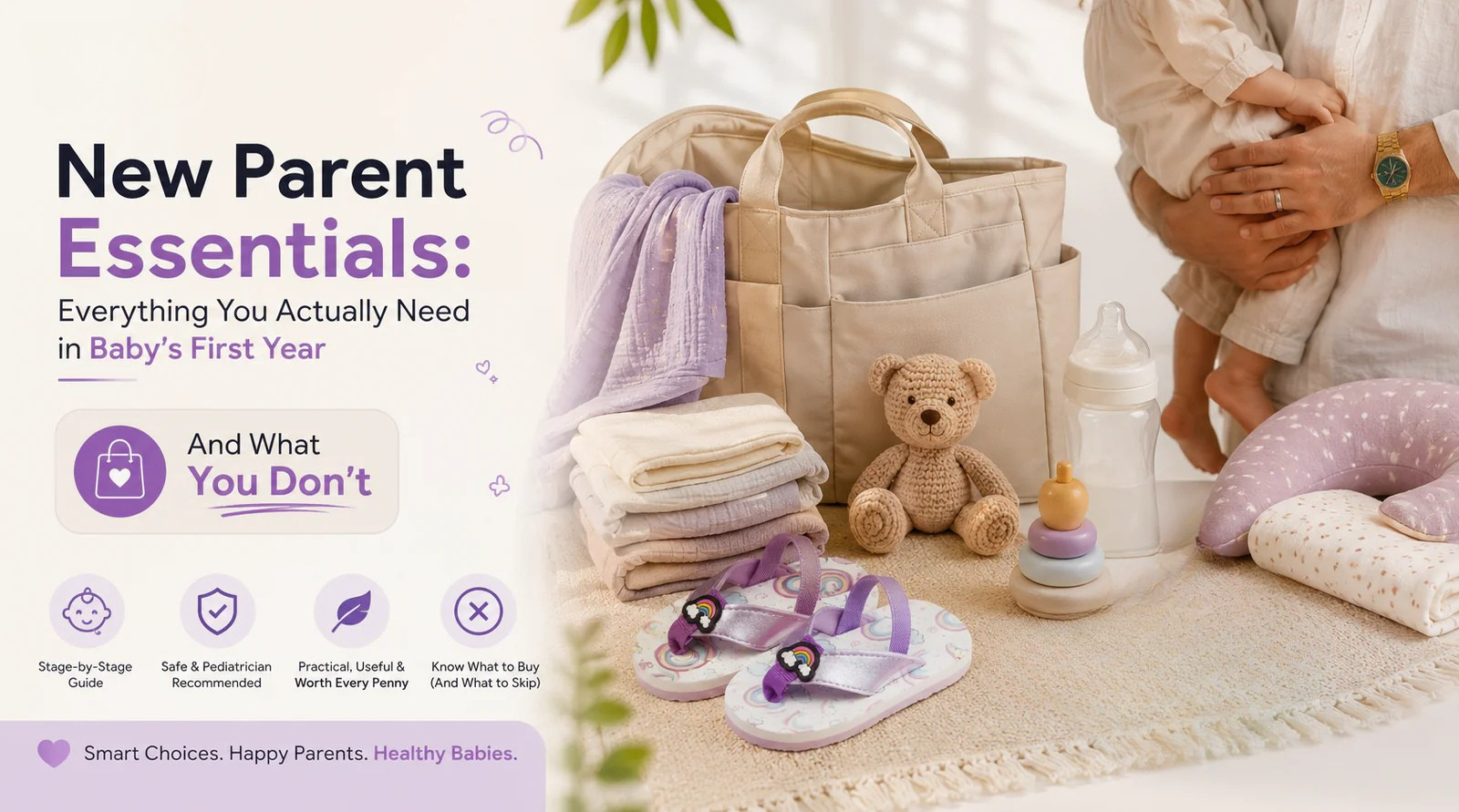
New Parent Essentials: Everything You Actually Need in Baby's First Year (And What You Don't)
Nobody tells you how much stuff comes with a baby.
Before the baby even arrives, the lists start. Baby shower wishlists. Gifting suggestions from relatives. Instagram reels about "must-haves" that seem to multiply every time you refresh the page. And by the time the baby actually gets here, your home looks like a small warehouse and you've somehow still run out of the one thing you actually needed at 3 AM.
This guide is different. It's written by people who've been through the first year, filtered through what paediatricians actually recommend, and organised by the stage your baby is actually in not by what looks good in a flat lay.
We've also been honest about what you can skip. Because just as important as knowing what to buy is knowing what will sit in the corner collecting guilt.
How to Use This Guide
This guide is structured by age band across the first year:
→ 0–3 Months: The Newborn Phase
→ 3–6 Months: The Discovering Phase
→ 6–9 Months: The Moving Phase
→ 9–12 Months: The Almost-Walking Phase
→ First Steps and Beyond: The Toddler Threshold
Jump to the section that matches where your baby is right now or read through if you're preparing ahead.
0–3 Months: The Newborn Phase
What you actually need:
Muslin swaddles (4–6)
The single most-used item in the first three months. Muslins are breathable, wash well, and work as swaddle wraps, burp cloths, nursing covers, and impromptu sun shields. Cotton muslin is better than synthetic, babies regulate temperature poorly, and synthetic fabrics trap heat. Budget: ₹300–₹800 for a pack of 4.
Newborn bodysuits / jhablas (8-10)
Babies spit up and soil through outfits multiple times a day. You need more than you think, and they need to be easy to change, snap closures at the bottom, soft fabric, and nothing tight around the neck. Indian jhablas are genuinely excellent for this stage: lightweight, loose, and designed for Indian summers. Buy in newborn (0–3M) and 3–6M sizes.
A reliable baby carrier / wrap
Hands-free time is precious. Soft structured carriers or ring slings work well for newborns. Look for ergonomic positioning (hips in M-position), breathable fabric, and weight-appropriate support. Indian summers are hot structured mesh carriers prevent overheating. Budget: ₹1,500–₹4,000.
Feeding essentials
Whether breastfeeding or formula-feeding, you'll need: breast pads if nursing, a good feeding pillow (U-shaped, firm), and sterilised bottles if formula is involved. A manual or electric breast pump is worth having available even if you plan to nurse exclusively supply fluctuations in the early weeks are common.
A firm, flat sleep surface
Not a bouncer. Not a rocker. Not a co-sleeper wedge. The safest sleep surface for a newborn is a firm, flat mattress in a cot or bassinet, with no pillows, loose blankets, or bumpers. India's heat means a thin cotton sheet and a ceiling fan are usually sufficient heavy blankets are not recommended.
Nappy changing basics
Diapers in newborn and size 1, cotton wipes (or water wipes for sensitive skin), a changing mat you can wipe down, and a good barrier cream (zinc oxide-based) for rash prevention. Skip the elaborate changing tables, a firm mat on the floor works just as well and doesn't have fall risk.
What you can skip at this stage:
Baby shoes. A newborn's feet do not need shoes. They're not bearing weight, not walking, and the foot is almost entirely cartilage. Booties or socks for warmth are fine — actual shoes are not necessary, and many are actually uncomfortable for feet this small. You'll know when it's time, we'll get to that.
Baby gym / activity arch. Nice, but not urgent. A baby under 8 weeks has very limited focal range (roughly 20–30 cm) and isn't ready to engage with hanging toys. Wait until 3 months.
Elaborate bedside organisers, wipe warmers, nappy disposal units. All solve problems that aren't really problems. A simple open caddy with diapers, wipes, and cream covers 95% of what you need.
3–6 Months: The Discovering Phase
What's happening: Your baby is starting to track objects with their eyes, reaching deliberately, and discovering their hands. Tummy time is becoming more productive. Social smiling has arrived. Sleep may or may not have gotten better (it's fine if it hasn't — most babies this age still wake at night).
What you actually need:
A play mat with tummy time support
Now the baby gym earns its place. A mat with a detachable arch and a few hanging toys supports the visual and motor development that's ramping up. Key: the mat itself should be padded enough to cushion tummy time but firm enough that baby doesn't sink. Thin foam mats on a hard floor work better than overly soft options.
Soft rattles and sensory toys
Lightweight, easy to grip, varied textures and sounds. At this stage, baby is working on reaching, grasping, and cause-and-effect. A rattle that makes a sound when shaken is genuinely stimulating. Choose items that can be boiled or wiped everything goes in the mouth from here.
High chair (get it ready, don't rush it)
If you're planning to start solids around 6 months (the WHO recommendation), have the high chair ready by 5.5 months. Look for: five-point harness, removable tray, easy to clean, recline option for early solids. Budget: ₹2,000–₹6,000.
Soft socks and non-slip pre-walkers
Baby's feet are growing and starting to kick more purposefully. Soft cotton socks for warmth. If you want something on their feet when on hard floors, non-slip fabric pre-walkers (very thin, no structure) are appropriate. These are not shoes, they're just grip socks with a thin sole.
What you can skip:
Jumperoos and doorway bouncers before 4–5 months. These require some neck and core stability before that, babies are not ready for them and they can cause strain. Check with your paediatrician on timing.
6-9 Months: The Moving Phase
What's happening: Rolling both ways, probably sitting unsupported (or almost there), and beginning to move along the floor crawling, bottom shuffling, or whatever variation your baby decides to invent. Everything is in the mouth. Everything goes on the floor. Everything gets pulled.
What you actually need:
Foam play mats or interlocking tiles
Once your baby is mobile on the floor, surface matters. Hard tile in Indian homes is the norm and while it's fine for sitting, it's unforgiving for the inevitable face plants and head bumps that come with early mobility. Thick interlocking EVA foam tiles create a safer crawling surface and are easy to clean. Budget: ₹600–₹2,000 for a sufficient area.
Board books
Cloth or thick board books now. Babies at this stage mouth them, bang them, and occasionally let you read a page before losing interest. Books with high-contrast images, simple patterns, and a single image per page work best. Indian publishers like Tulika Books have excellent options in multiple Indian languages.
Stacking cups and rings
The classic stacking toy earns its place in this window. Babies are working on grip, release, cause-and-effect, and early spatial understanding. A good set of stacking cups is used for years in the bath, in sand, at the table.
Baby-proofing essentials
If you haven't started: socket covers, cabinet latches, corner guards on sharp furniture edges, and gates for staircases. In Indian homes, additional considerations include low-hanging cords (ceiling fan pull cords), heavy pots within reach in the kitchen, and low bookshelves.
What you can skip:
Walker rings (the rolling seated baby walker). Multiple paediatric bodies including the Indian Academy of Paediatrics advise against these. They are associated with delayed independent walking and carry significant fall risk on uneven surfaces and near stairs. They're banned in Canada. Skip them.
9–12 Months: The Almost-Walking Phase
What's happening:
This is the big one. Your baby is pulling to stand on every surface that will hold their weight, cruising along furniture, letting go for a terrifying second before grabbing on again, and in many cases taking their first independent steps somewhere in this window.
This is the most exciting developmental window of the first year, and it's also the one where the right footwear finally starts to matter.
What you actually need:
A push walker (not a ring walker)
A push walker, the kind baby stands behind and pushes across the floor is excellent at this stage. It gives support while allowing the child to control their own balance and pace. Look for one with adjustable resistance (so it doesn't move too fast), a sturdy base, and a comfortable handle height. Budget: ₹800-₹2,500.
First walker shoes, when they're ready
The timing matters. Shoes before independent walking aren't necessary. But once your baby is taking steps or cruising confidently and close to walking a proper first walker becomes important, especially if they're moving on outdoor surfaces or away from home.
What makes a good first walker shoe:
Flexible sole - should fold in half easily. If it doesn't, it restricts the natural toe-off motion your baby is learning.
Lightweight - heavy shoes fatigue tiny legs. At this stage, the shoe should feel like almost nothing.
Breathable - babies' feet sweat significantly. Mesh panels or soft leather help.
Well-fitted - approximately 1 cm of growing room at the front. Feet grow fast at this age (a full size every 2-3 months is common).
Secure fastening - velcro closures are significantly easier than laces for this age group.
Low or no heel - any heel shifts weight unnaturally and can affect the walking pattern your baby is developing.
ONYC's first walker shoes are designed specifically around these principles flexible, breathable, lightweight, and built for Indian climate conditions. Starting at ₹599.
Our most-loved first walkers, rated by thousands of Indian parents:
→ Ducky Toddlers' First Step Shoes – Sky Blue & Yellow | ₹599 | Rated 4.83 by 257+ parents | Unisex
→ Cloudy Toddlers' First Step Shoes – Sea Green | ₹599 | Rated 4.85 by 196+ parents | Unisex
→ Shady Toddlers' First Step Breathable Shoes – Teal Blue | ₹599 | Rated 4.84 by 177+ parents | Unisex
→ AIRY Toddlers' First Step Breathable Shoes – Peach | ₹599 | Trending | Unisex
Browse the full first walker range here. Not sure about sizing? Use the ONYC Size Finder to get the right fit before ordering feet grow fast, and a well-fitted shoe makes a real difference.
If you want to understand what to look for in more detail before buying, read our guide: Your Baby Just Took Their First Step. Now Everyone Has an Opinion. [link to Blog 1]
Shape sorters and simple puzzles
Fine motor development is accelerating. Shape sorters (classic wooden ones, specifically) hit almost every developmental target in this window - spatial reasoning, cause-and-effect, problem-solving, and grip. The wooden versions outlast plastic by years.
Bath toys
Pouring, filling, squirting all of this is play that develops hand strength and coordination. Simple bath toys that can be fully cleaned (check for hidden mould traps in squeeze toys) are excellent at this stage.
What you can skip:
Electronic learning tablets and "educational" screens. The research on screen time for under-2s is clear and consistent: there is no developmental benefit, and there are potential downsides including delayed language development. Passive screen time is not the same as interactive play. Save the screen time for later.
First Steps and Beyond: The Toddler Threshold
Once independent walking arrives whether at 10 months or 15 months (both within normal range) your needs shift meaningfully.
The phase after first steps is defined by:
- Rapid footwear turnover (feet grow fast; check fit every 6–8 weeks)
- More time outdoors and on varied surfaces
- More independent play and exploration
- Increasing need for durability, not just softness
At this stage, you'll want:
A rotation of footwear for different contexts:
For everyday indoor/outdoor use: a pair of flexible, lightweight shoes. ONYC's first walkers cover this.
For warmer months, outdoor play, and summer visits: sandals that stay on and don't rub. ONYC's girls' sandals and boys' sandals are built without sharp edges and designed for active wear. Starting at ₹399.
For quick slips on and off at home or at family events: sliders that are easy to put on and don't fall off when running. ONYC's kids' sliders work well here.
For beach trips, monsoon season, or just the chaotic slipperiness of Indian summer afternoons: flip-flops with grip. ONYC's kids' flip-flops - starting at ₹349.
Browse the full kids' footwear range at ONYC
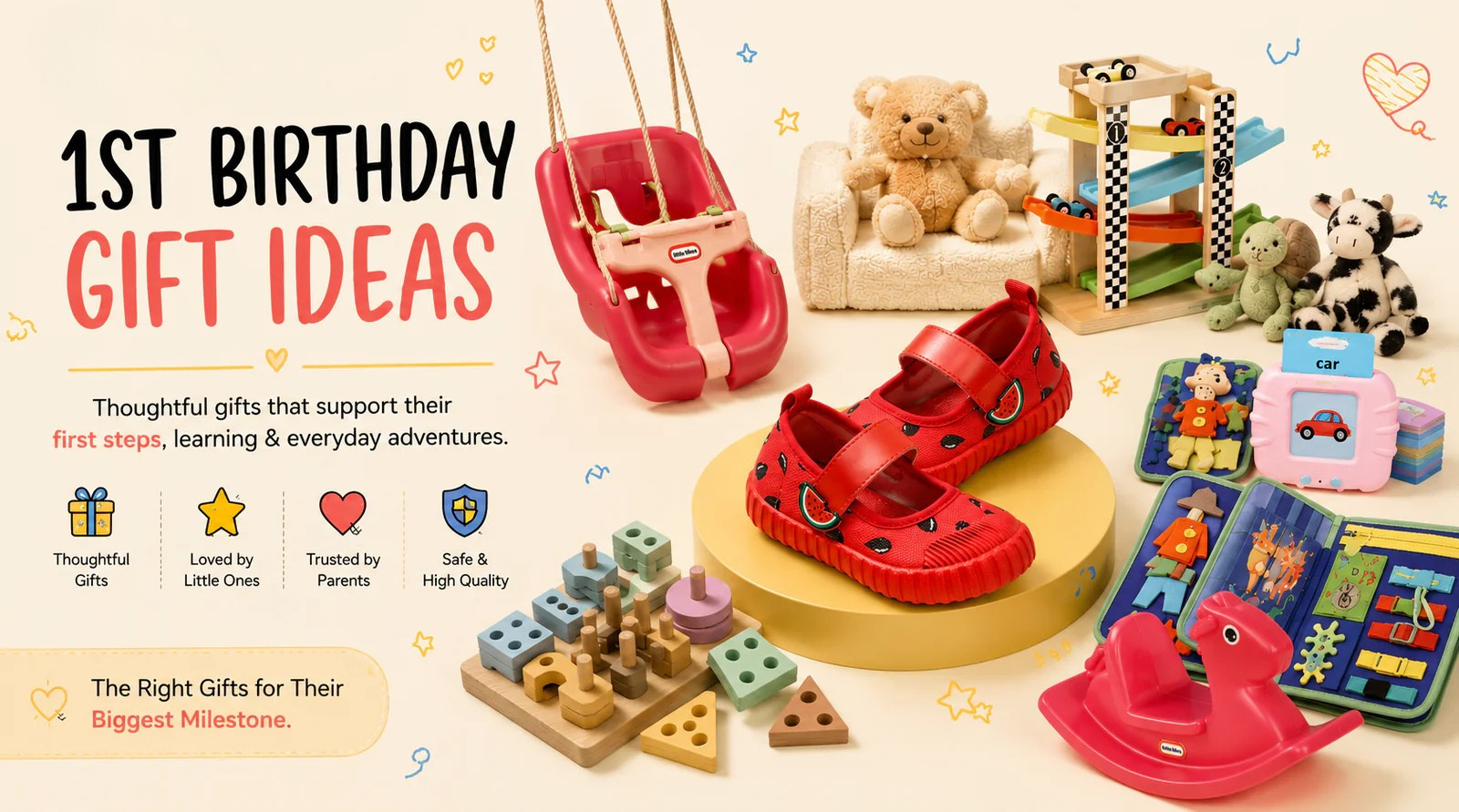
For a deeper guide on choosing footwear at this stage, read: First Birthday Gift Ideas for Babies: Gifts That Grow With Them
A Note on Indian Traditions and This Guide
Indian parenting exists within a web of traditions that shape when and how babies receive things and this guide respects that.
The godh bharai (baby shower) typically happens before birth and is often when the big practical items arrive: cot, pram, carrier, feeding gear. If you're building a godh bharai wish list, focus on the 0–3 month section above.
The naamkaran (naming ceremony) in the first few weeks is often when the first wave of family gifts arrives typically clothes, silver jewellery, and money. Practical gifting suggestions for this occasion can be found in our guide on first birthday gifts.
The annaprashana (first solids ceremony) around 6 months is a good prompt to ensure your high chair and weaning supplies are in order.
And the first birthday dasya (or whatever your family calls it) is when the footwear gifting becomes genuinely meaningful. A pair of ONYC first walkers at the first birthday is one of the most purposeful and timed gifts a family can give: milestone-appropriate, developmentally relevant, and beautiful enough to photograph.
FAQ
Q: What do new parents actually need for a newborn?
A: The essentials for a newborn are fewer than most people expect: muslin swaddles, soft bodysuits (8–10), a firm flat sleep surface, a baby carrier, feeding supplies, and nappy-changing basics. Most other items bouncers, elaborate organisers, baby shoes can wait until the baby is developmentally ready for them.
Q: When do babies need their first shoes?
A: Babies don't need shoes until they are walking independently and regularly on outdoor or unprotected surfaces. Before that, barefoot on clean indoor surfaces is ideal for foot development. Most babies reach this stage between 10 and 15 months. The shoe should be flexible, lightweight, breathable, and properly fitted not rigid or structured.
Q: What are first walker essentials?
A: For first walkers, you need: a flexible, lightweight shoe with about 1 cm of growing room at the front; a push walker to build balance before independent steps; foam floor mats for safe indoor play; and shape sorters and simple developmental toys. Avoid rolling baby walkers, which paediatric organisations advise against.
Q: What is the difference between pre-walkers and first walker shoes?
A: Pre-walkers are soft-soled fabric shoes or grip socks worn before independent walking they protect feet but have no structure or protective sole. First walker shoes are worn once a baby is walking independently on outdoor surfaces. They have a thin but protective rubber sole, a flexible structure, and are designed to allow natural foot movement while shielding the foot from surfaces.
Q: How often should I replace my toddler's shoes?
A: Check fit every 6-8 weeks in the early walking years. Feet can grow a full size every 2-3 months during this period. Press your thumb at the front of the shoe with the child standing if there's no room, it's time to size up. Worn-down soles or any signs of the shoe twisting the foot are also signs to replace.
Q: What baby products should I avoid buying?
A: Avoid: rolling baby walkers (associated with walking delays and fall risk, advised against by the Indian Academy of Pediatrics), baby shoes before walking (unnecessary and often uncomfortable), electronic learning tablets for under-2s (no developmental benefit), and wipe warmers or nappy disposal units (solve non-problems).
The Honest Summary: What You Actually Need vs. What Gets Sold to You
What you need: muslins, bodysuits, a firm sleep surface, a carrier, a feeding setup, a play mat, board books, stacking toys, foam floor tiles, a push walker, and when the time is right, a proper pair of first walker shoes.
What you don't need: baby shoes before walking, electronic "educational" tablets, rolling baby walkers, elaborate changing stations, wipe warmers, or 47 varieties of the same type of toy.
The first year is loud, exhausting, and genuinely wonderful. The stuff that helps most is almost always simpler than the algorithms suggest.
Get the essentials right. Let the rest go.
Shop at ONYC. India's most-loved kids footwear brand (https://onyc.in/). Trusted by 9 lakh+ parents. Delivered to 20,000+ pincodes.